Instruments & industry / Project story
NIR spectrometer control software
My work at Bruker connects hardware interfaces, real-time data processing and measurement workflows in software for networked NIR instruments.
01 / Context
Context
As a Senior Software Engineer at Bruker, I work on control software for networked NIR instruments. My contribution focuses on hardware interfaces, systems integration and real-time data processing between the instrument and the application.
02 / Requirements
Requirements
Measurement workflows must meet the hardware’s timing requirements. Networked installations also need protected methods, central permissions, and a record of changes.
03 / Implementation
Implementation
The application combines React and Electron interfaces with C++ for hardware access and time-sensitive processes. Within this system, I work on the connection between device communication and measurement workflows. The software supports automated measurements, live visualization, calibration and data export.
Networked installations also require central administration of instruments, methods, users and data. Method protection, trend analysis and audit trails make workflows traceable across sites. These requirements form the context for my integration work; the application is a broader team product.
04 / Outcome and project status
Outcome and project status
My contribution connects hardware interfaces and measurement workflows within the control software for networked installations.
Instrument and software
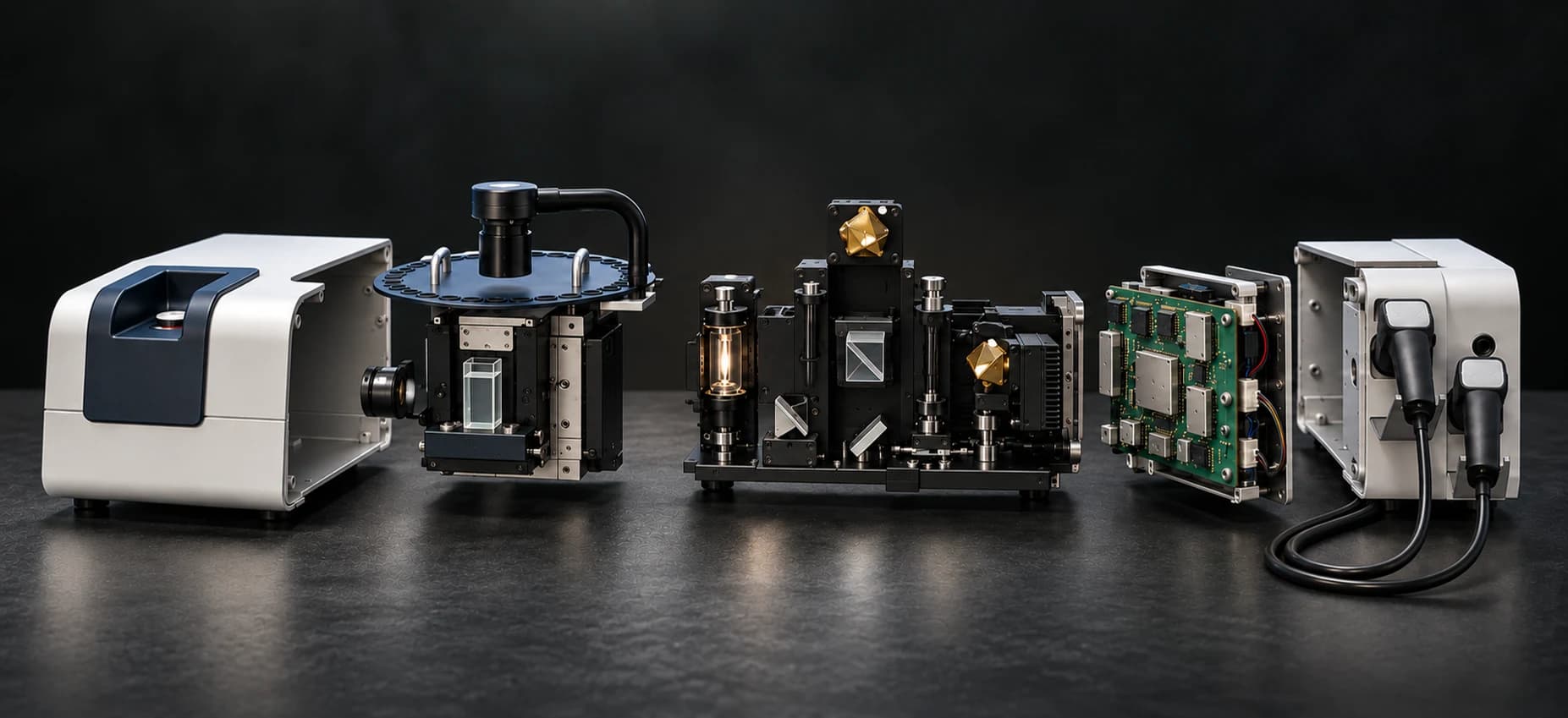
Assemblies and software
Enclosure
The enclosure protects the measurement assembly from external influences. The software monitors instrument status, controls the instrument and supports error detection and recovery.
Sample stage
Place the sample. Know the state. Device communication coordinates positioning and acquisition, and makes the instrument’s status visible to the operator.
Optics
The interferometer splits, reflects and recombines light. The software calculates a spectrum from the measured interferogram and supports calibration and repeatable acquisition.
Detector
The detector converts light passing through the sample into an electrical signal. The software records measurement data with timestamps and parameters and handles transmission errors.
Electronics
The electronics acquire and process the detector signal. The software validates readings and displays uncertainties and unexpected values.
Connections
The interfaces connect the instrument to operational workflows. The software manages permissions, exports results and records changes.
Project images